










Deconstructing Hræzlyr
From Jet Turbines to Komodo Dragons
Spoiler warning! We recommend playing through the game first before reading through this story.
We're excited to celebrate our art department throughout this week's ArtStation Art Blast. Check out our team's beautiful artwork and then read on below to get a deeper look into how we created Hræzlyr.
Dragons had never been seen in the God of War franchise. That is, until now. They are weird, wonderful, vicious and monstrous beasts. Although dragons have been realized in countless ways across entertainment mediums, our team has taken on the task of bringing them to the Norse wildlands. One of these dragons is Hræzlyr, the Mountain Dragon, who stands tall as one of the game’s biggest bosses. From its intricate concept designs to the serpentine animations, find out how our team made this dragon standout like no other.
Tackling the Design and Movement
One directive our team was asked to focus on was to create a dragon that would stand as a premiere boss battle in our game. Our lead character concept artist, Dela Longfish, remembered the team’s excitement about delving into these new creatures, which were brand new to our God of War franchise. “Dragons are something new that we haven’t seen before in the pantheon of creatures from the Greek Universe, so it was a really fun task to start looking at what a dragon could be.” The team wanted to create a dragon boss that would not only stand proud with previous gigantic creatures, but also stands out in terms of dragons in popular culture. Dela explained, “We had a few of them and wanted to make sure this one felt different, so you can tell that the way this one looks is different than the other ones you encounter in the game. It was intentional to make this one stand out.”
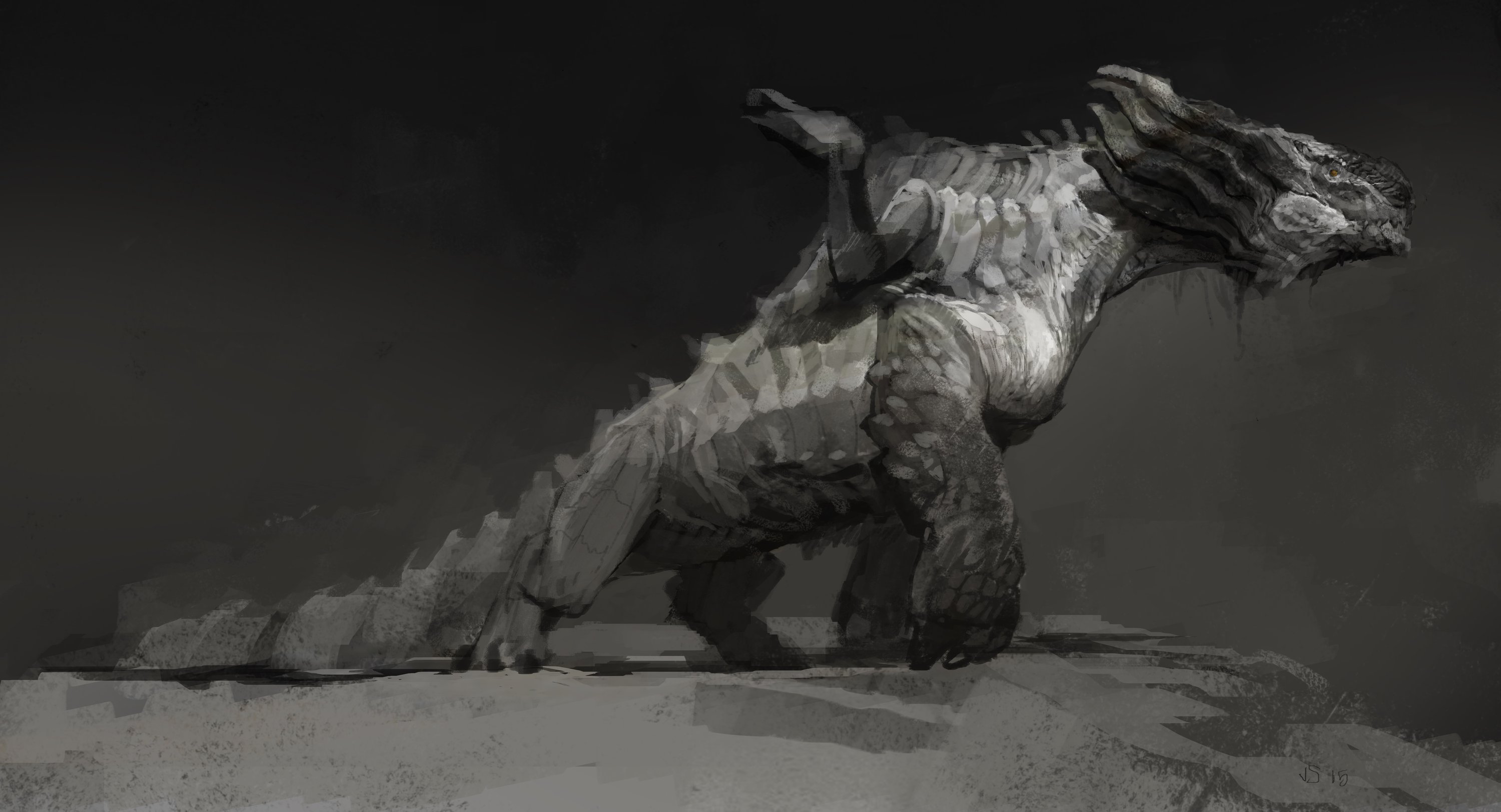
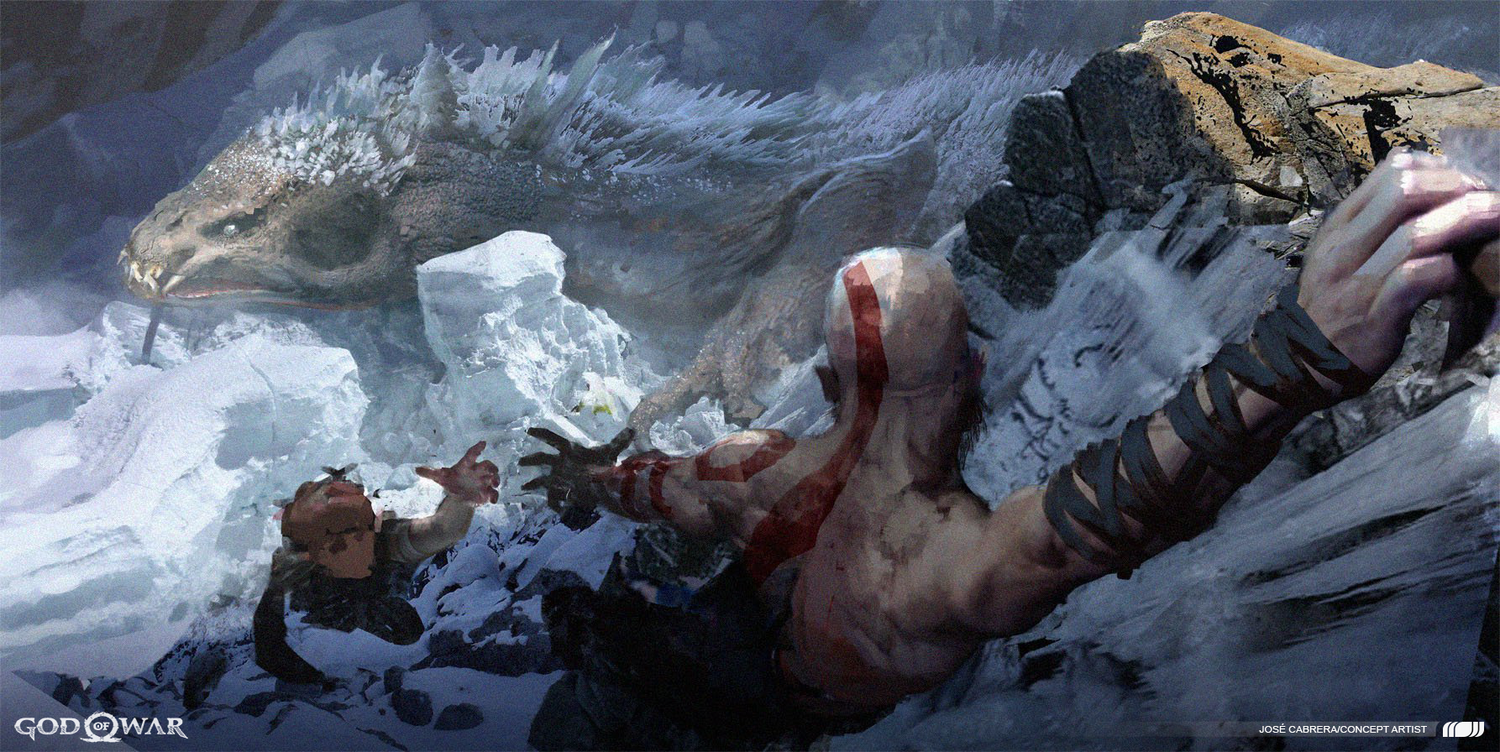
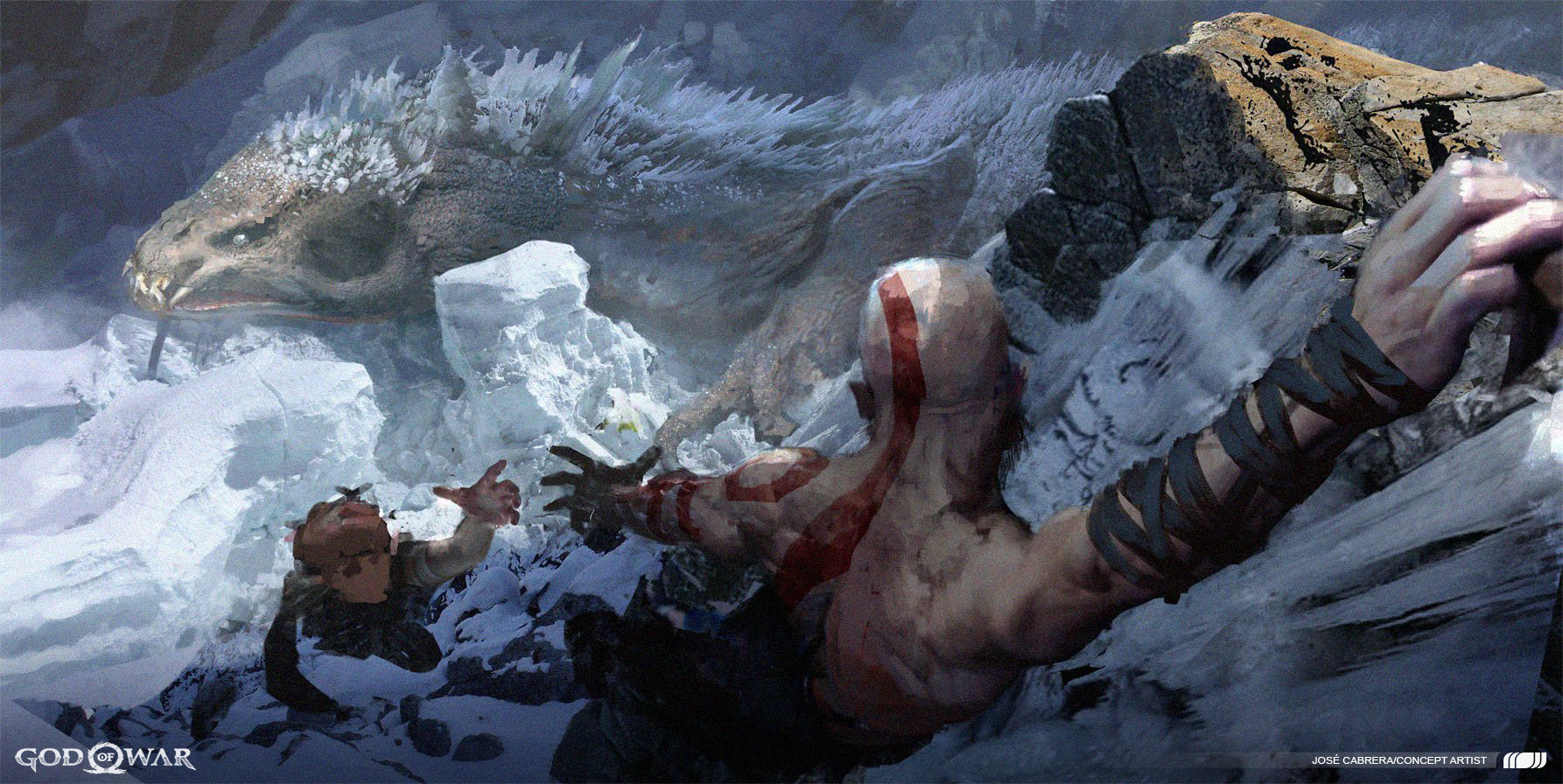
Our concept artist, Stephen Oakley, pointed out one particular inspiration that took place with aquatic animals while creating early designs of Hræzlyr. “I know that the earliest thoughts revolved around this mechanic of the dragon being like a jet turbine. Something that’s terrifying and that could be a fun gameplay mechanic (with the suction pulling enemies, and characters towards it).” This gameplay mechanic led to artists José Cabrera, Vance Kovacs and Justin Sweet using different aquatic creatures to create a design. “There was a piece that José had done early on that helped catapult the design forward. He had something that looked like a basking shark embedded into the belly of the dragon. I was looking at bass, which some fish had a surprising amount of suction for. This ended up inspiring a lot of features that are still inside of the Dragon today like the gills and it led to us trying to think of creative ways that were inspired from real life – to think about how they would be able to do the things that he does.”
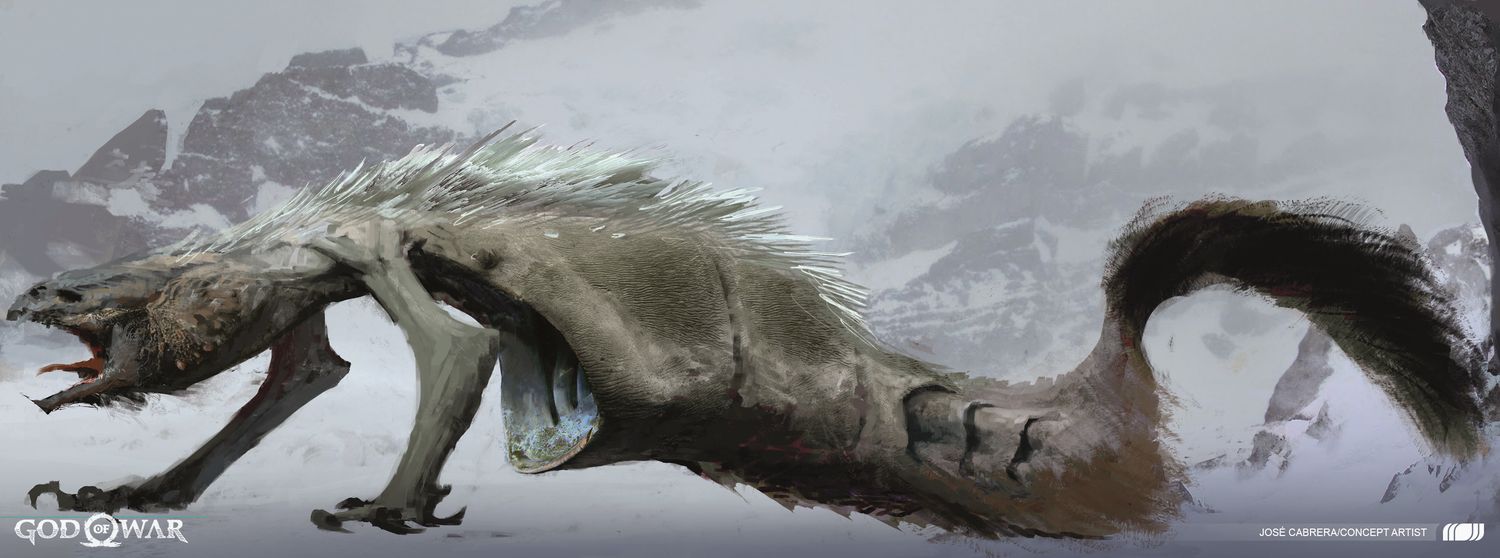
On the animation front, the inspirations were focused on various creatures that create loud and powerful footsteps. Our Animator, Sophie Evans, recollected, “A lot of reference came from lizards, komodo dragons and tigers. These animals tend to be really heavy.” The movements of the Mountain Dragon needed to be powerful and strong, she said. “A lot of muscular animals like bears and tigers – they feel heavy because they have a lot of secondary motion from their muscles. With film and TV, you can get a lot of this type of movement, but in games usually, you don’t have the tech or support to have simulations on the muscles. So, I tried to imitate that secondary motion feeling with just the torso, so it’s really exaggerated – the up/down movement on the torso and even the exaggerated lateral left and right. This gives the dragon serpentine movements. So a mix of reptilian back and forth mixed with really heavy up and down bounce is how I tried to approach this.”
Can You Kill Something That Big?
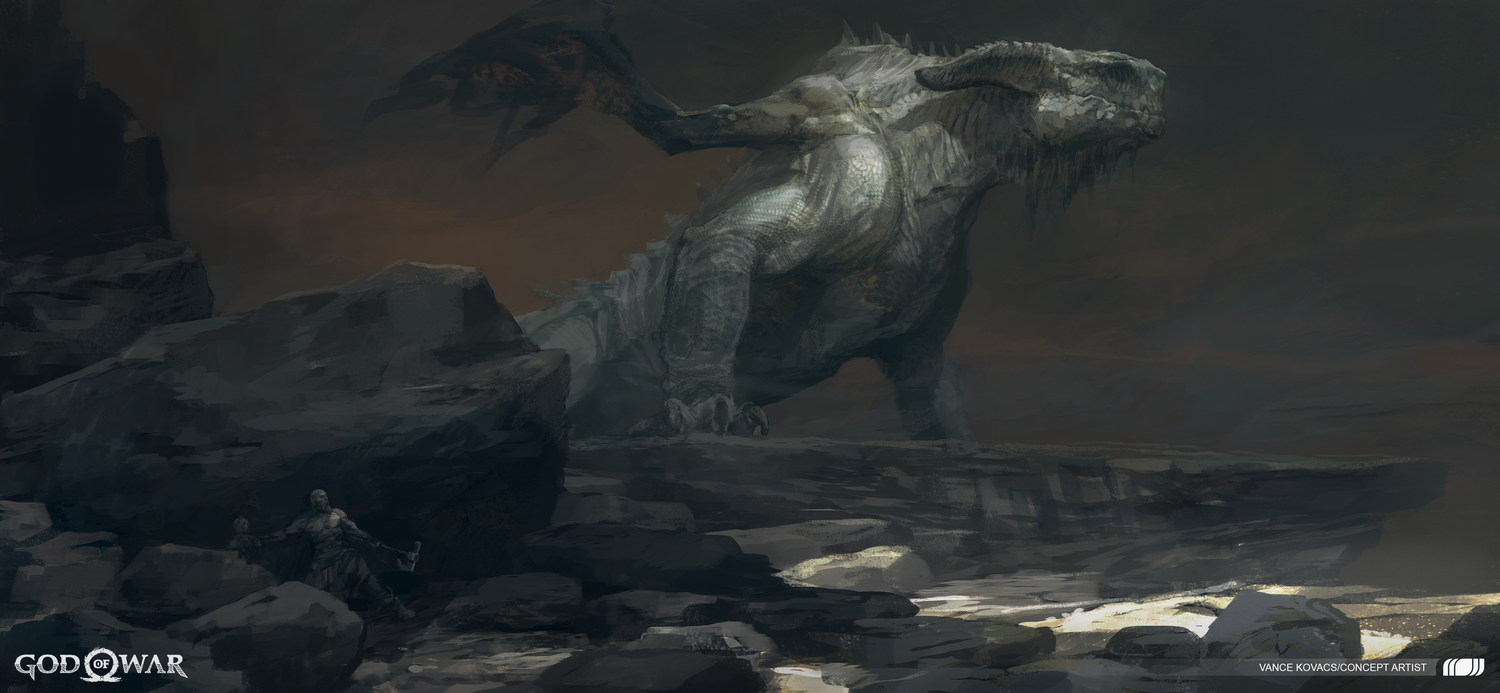
God of War has always been known for larger than life spectacle moments we want you to never forget. Bringing dragons into our universe was a clear opportunity to measure up to that. When you encounter Hræzlyr, it feels like a Titan towering over you. Dela mentions, “This was our first huge boss. We got to have something super big and you would be taking on something larger than you. We wanted to get that classic God of War scale and say this looks undefeatable - and what really stood out was the scale and the mythology.”
Where in past God of War games we had the luxury of manipulating and cutting the camera away for big set piece moments, in this game, our no cut camera was a monstrous challenge when dealing with dragons, specifically when it came to animation. Because of our new over the shoulder camera perspective, the positioning and posing of the dragon was a very delicate calibration itself. Sophie mentions, “With this camera, you have to be really far back to see the dragon or keep him really low to the ground. In the cinematic moments, it’s much easier to make the dragon feel scary and powerful because we have full control of the camera. When we’re using the regular gameplay camera, we had a lot of trouble keeping him on screen because of the scale.”
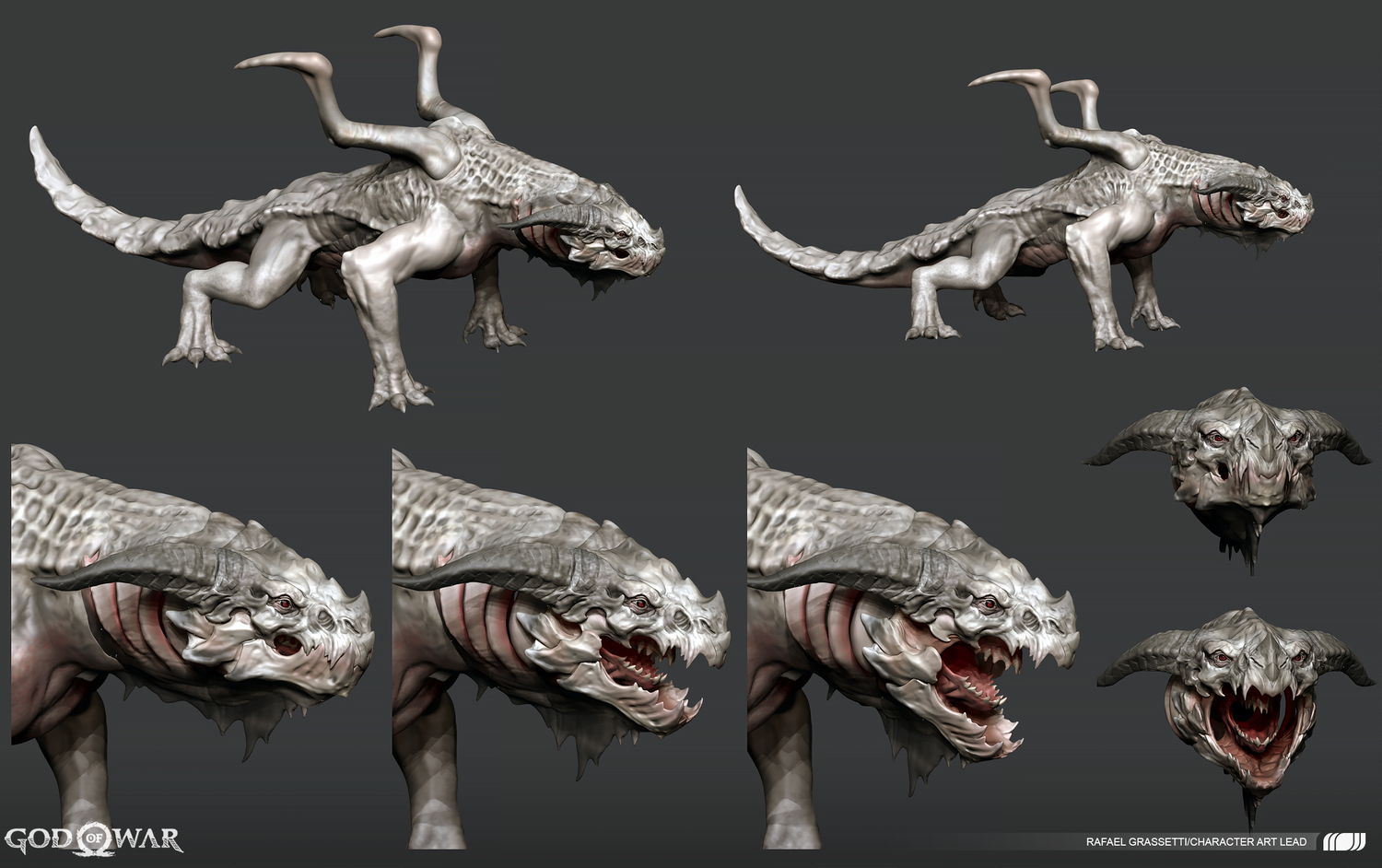
However, the closer camera allowed many clever and rewarding solutions to come about. As Sophie mentioned, “As much as the camera feels like a restriction in these moments, it’s also an opportunity to make it feel even grander because you can make it feel more close to reality. The first instinct is to pull the camera really far so you can see everything but there’s something pretty nice about keeping it close and grounded.”
The animation team took a lot of time trying out different poses and exploring ways to show off the dragon, so that it could be presented and visible with our camera. To solve this, the animators changed the positioning of the dragon, “So in the end, we ended up putting him on a slant downhill so his head could be closer to the ground. When you think of the typical proud dragon poses, the head is usually pretty high. But then, it’s an interesting challenge to see how can you keep that powerful looking presence and keep his head low to the ground.” The same challenge came with Hræzlyr's attacks. With the closer camera, the animators needed to always think of how the player would react properly, while still being fun on a gameplay level. Sophie states, “For instance, with the claw attack, my first instinct is to raise the claw as high as possible to get a really strong slam down, but then you lose the claw in this camera view, which really isn’t fair for gameplay. So we had to find a way to make it feel strong, while keeping everything visible and intact.” The end result is a breathless battle that felt monumental.
I know that the earliest thoughts revolved around this mechanic of the dragon being like a jet turbine. Something that’s terrifying and that could be a fun gameplay mechanic.”
-
These moments were important to bring to the forefront. “One of the proudest moments is an early test animation I did of the dragon stomping across the arena over Kratos’ head,” Sophie remembers. “Even our creative director, Cory, got excited after seeing that because it was the first sort of thing that tapped into the spectacle that we were trying to get. For gameplay, it’s challenging to have something so big on top of Kratos. Thankfully, we were able to keep those moments and have them interspersed in the fight.”
Another challenging hurdle with Hræzlyr's battle were the outdoor sequences and lighting issues. The battle against the Mountain Dragon happens in two different spots – the interior of the mountain on the lift and then in an outdoor arena on the side of the mountain. Dela mentions, “We were looking for all the elements we wanted to combine with the dragon and make sure that it fit with the gameplay needs at the same time. What we actually had in the combat was that we started in an interior space with the climax being in the exterior space and then making sure the design held up for both of those, so that’s why we did a lot of revisions on it – we were working with two different spaces, one encapsulated completely in the dark and one in pure light,” Dela mentioned.
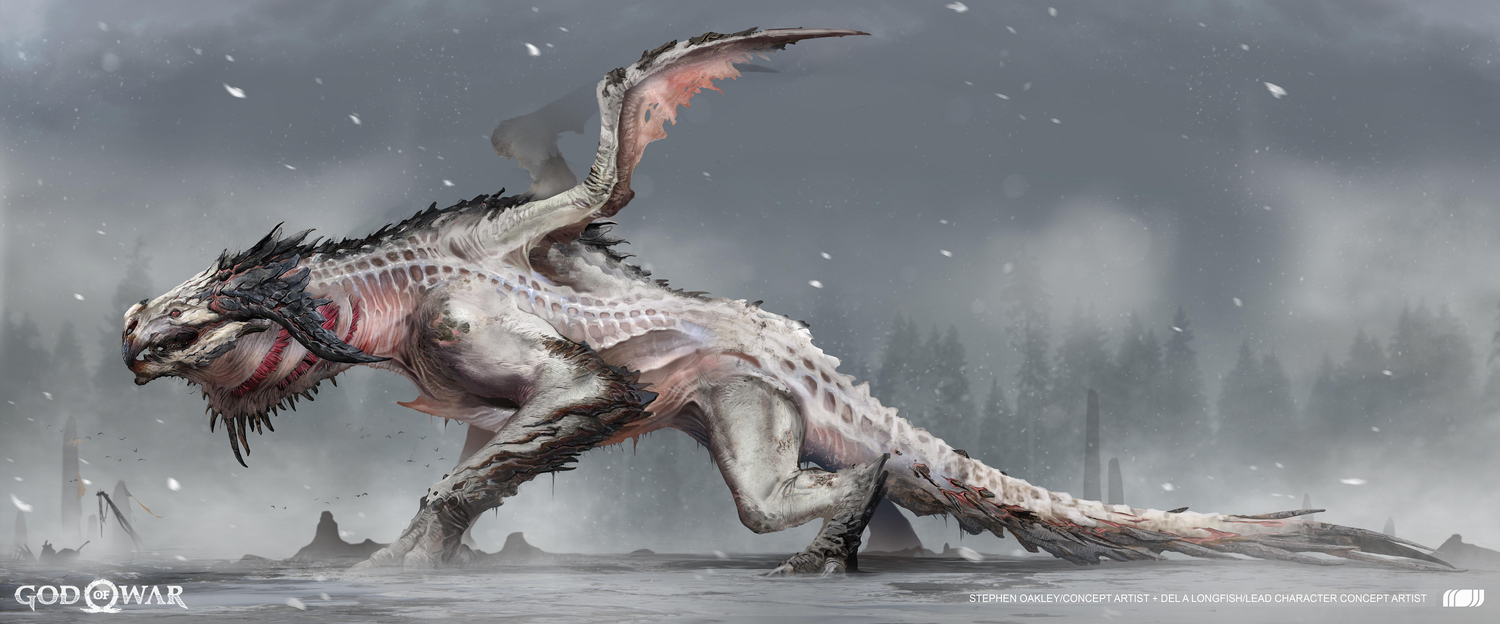
Stephen remembered the many revisions made to get the Hræzlyr just right, all the way up through production. “So he’s a super complex kind of thing to design because you’ve seen a million different dragons since the dawn of time and we wanted to make sure these were unique but familiar. We worked with all the mechanics and that all of a sudden started to fall apart in certain lighting because we had chosen specific colors. Originally, the dragon was going to be all albino, but as soon as it went outside, as huge as it was, it started to blend into the sky, so it was just a perpetual struggle as the game continually progressed. So the dragon had to be changed little by little as the project progressed and new challenges arose. It was an interesting task to keep up with those changes, where we would work on changing the design and model, and then get it back over and over again for a lot of the project. We just had to keep adjusting it as it progressed to make sure it fit the experience and expectations of the players.”
Climbing the Mountain Together
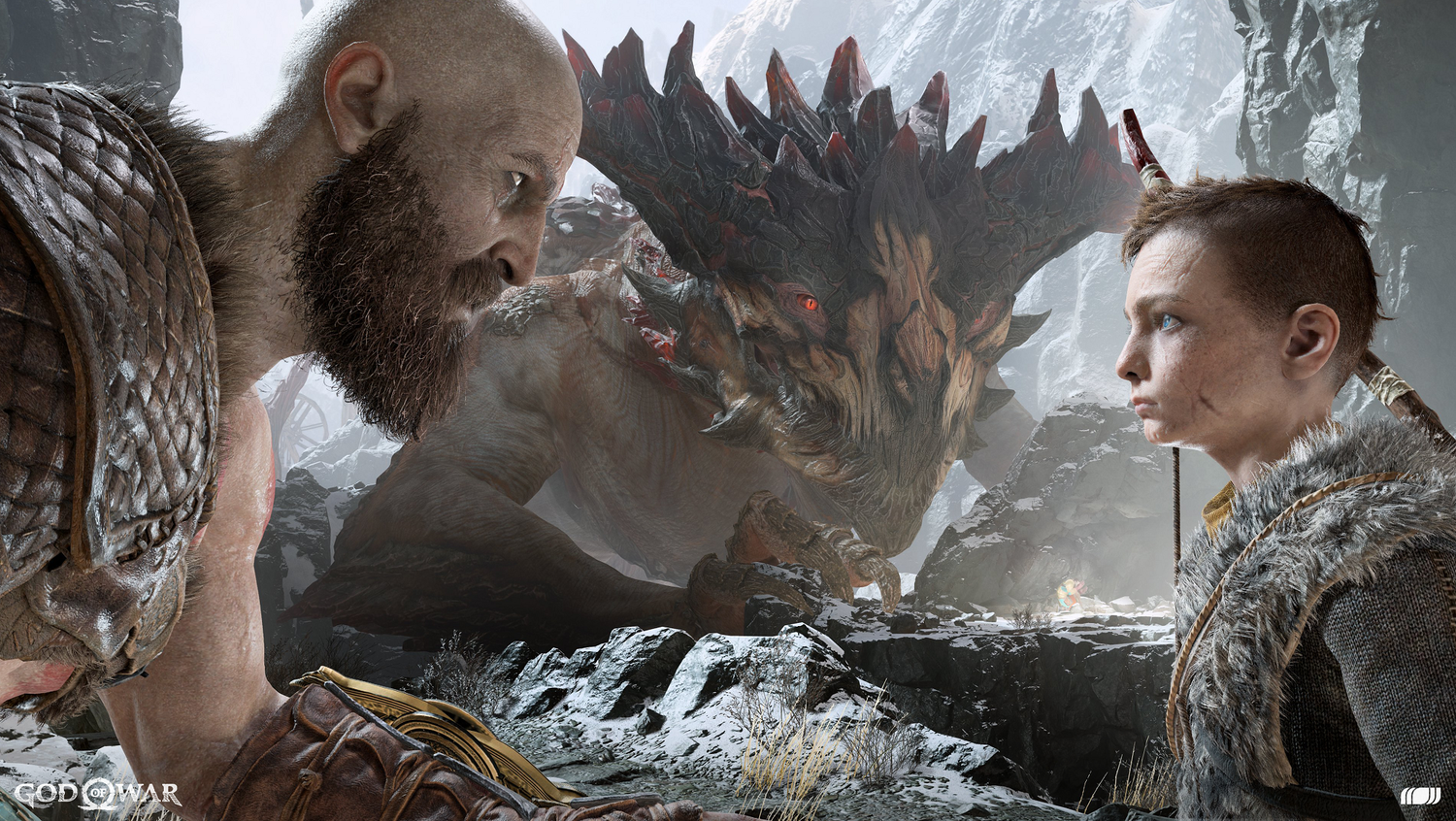
In the end, our team felt that they overcame a huge hurdle, creating an exciting and memorable thrill ride. Sophie hoped that through the team’s work and collaboration here, players remember the boss experience both because of its spectacle and emotional impact. “I think I wanted people to feel like they were on a roller coaster ride and have fun. I wanted the dragon to be believable enough that the player would feel bad after they killed it. If they felt a bit of remorse, it would mean I did a good job in making it feel alive.”
Stephen was very proud of the team’s work here, stating, “The end result was something that people were still super excited about, despite all the iterations and compromises. It still ended up being something that we all had a hand in creating, so it was just a cool thing to step away from and say, this is the amalgamation of everyone that built this big, bad beast.”
Make sure to visit ArtStation to view our team's Art Blast for God of War.
-
Watch Raising Kratos
Raising Kratos is more than just a “making of,” this cinematic journey of second chances rooted in family, sacrifice, struggle and doubt follows game director Cory Barlog and those who chase perfection in art and storytelling. Witness the incredible defeats, the unpredictable outcomes and the down-to-the-wire tension on full display in this true-life redemption story.

-
Announcing Raising Kratos
On the one year anniversary of its release, we’re excited to share this peek behind the curtain of God of War’s very own Santa Monica Studio with a trailer for our upcoming film, Raising Kratos. This full-length feature documentary, coming very soon to PlayStation YouTube, is an exploration into the massive undertaking it took to change the course of the God of War Franchise.
-
Making History
"If you make something with passion, that passion is contagious." We partnered with Guinness World Records to surprise one of our greatest fans - Emmanuel Mojica Rosas. He is a fan for the ages, and this is a story we think you will never forget. Not to mention, we also reveal some incredible new merchandise from our dear friends at Mondo.
-
Thank You
Together we all dream big dreams. Dreaming big has led to an amazing sense of accomplishment for all of us here at Santa Monica Studio and it’s the belief in that dream that kept us going, from the very moment we set out to create a new beginning for God of War.




















LEGAL &
PRIVACY
CALIFORNIA
PRIVACY